Mastering Precision with Box Packaging 3d Mockup Die-Cut Solutions
In the rapidly evolving landscape of product design and branding, the transition from a digital concept to a tangible reality requires precision. For professionals seeking to validate their designs before mass production, the Box Packaging 3d Mockup Die-Cut has emerged as an indispensable tool. This technology bridges the gap between creative vision and manufacturing feasibility, allowing designers to visualize, test, and refine their concepts with unparalleled accuracy.
The core value of this asset lies in its ability to provide a realistic representation of the final product. Unlike standard flat templates, a three-dimensional mockup allows stakeholders to see how graphics wrap around corners, how textures interact with light, and how the structural integrity holds up under various conditions. By utilizing high-fidelity files, businesses can avoid costly errors associated with premature printing runs or structural failures.
The Architecture of Digital Prototyping
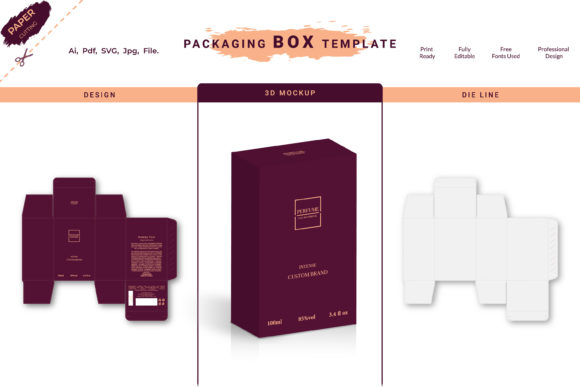
Understanding the technical composition of these files is essential for maximizing their utility. A comprehensive package typically includes a variety of formats designed to cater to different stages of the design workflow. The inclusion of multiple file types ensures that users can work within their preferred software environment while maintaining the highest standards of quality.
AI File: The Adobe Illustrator source file serves as the foundation for vector-based editing. This format allows designers to manipulate shapes, adjust colors, and modify text without any loss of resolution. Because vectors are mathematically defined, they remain crisp regardless of how much they are scaled, making them ideal for both small labels and large packaging structures.
PDF Print File: Portable Document Format (PDF) files are crucial for pre-press preparation. They preserve the layout and vector data, ensuring that when the design is sent to a printer, the output matches the on-screen preview. This format is particularly useful for communicating specific print requirements, such as bleed areas and crop marks, to manufacturing partners.
SVG File: Scalable Vector Graphics offer web-friendly versatility. While often used for web icons, SVGs are equally powerful for creating responsive packaging designs that need to be viewed across different devices. They allow for interactive elements and precise scaling, which is beneficial for digital catalogs or online configurators.
Jpg File: High-resolution JPEG images provide immediate visual feedback. These rasterized versions are perfect for quick presentations, social media previews, or situations where vector editing software is not available. They offer a photorealistic look that helps non-technical stakeholders understand the final aesthetic immediately.
Workflow Integration and Layer Management
The efficiency of using a Box packaging and 3d mockup die cut template design depends heavily on how well it integrates into existing workflows. One of the most critical features of these assets is the layer management system. Designers are provided with separate layers that correspond to different parts of the box structure, such as the front panel, back panel, flaps, and side panels.
This separation allows for non-destructive editing. When placing artwork, the designer can place it above in a separate layer, ensuring that the underlying structural lines remain intact. This approach prevents accidental overwriting of critical guides and makes it easy to toggle visibility to check alignment. It also facilitates rapid iteration; if a client requests a color change on the side panel only, the designer can isolate that layer and update it without affecting the rest of the design.
The process begins with unzipping the archive using standard software like WinRAR or WinZip. Once extracted, the user opens the AI file in Adobe Illustrator. The interface will display a complex arrangement of paths and groups. By locking the background layers containing the die-line, the designer creates a safe workspace. They then import their artwork, aligning it precisely with the designated art boards. This method ensures that the final design adheres to the physical constraints of the box, preventing issues like text being cut off during folding.
From Digital to Physical: The Manufacturing Connection
While these files are primarily for visualization, they hold significant weight in the manufacturing phase. The prompt indicates that the files themselves are ready for cutting on the die-cutting machine. This capability transforms the mockup from a mere visual aid into a functional blueprint. In traditional workflows, converting a 3D render into a flat pattern required manual tracing, a process prone to human error and time consumption.
With modern Box Packaging 3d Mockup Die-Cut assets, the die-lines are already vectorized. This means that the path data can be directly exported to CNC machines or laser cutters used in prototyping facilities. The precision of the vector data ensures that the cuts are clean and accurate, reflecting the exact dimensions of the intended box. This direct line from design to production significantly reduces the turnaround time for prototypes.
However, it is vital to distinguish between the digital template and the physical creation tool. The product description clarifies that no template for making the physical box is included in the sense of a physical metal die. Instead, the digital file provides the blueprint that guides the creation of that physical die. This distinction empowers businesses to outsource the physical tooling while retaining full control over the design specifications.
Applications Across Diverse Industries
The versatility of these mockups extends far beyond simple product boxes. Their application spans numerous sectors, each with unique requirements for presentation and functionality.
- Retail and E-commerce: Online retailers rely heavily on visual fidelity to convert browsers into buyers. A realistic 3D mockup allows customers to rotate the product, inspect the finish, and gauge the size relative to other items. This reduces return rates by setting accurate expectations.
- Food and Beverage: In the food industry, packaging must convey freshness and safety. Using these templates, designers can experiment with different finishes, such as matte or glossy laminations, to see how they enhance the appeal of the brand logo and nutritional information.
- Cosmetics and Luxury Goods: High-end brands demand perfection. The ability to resize artwork without loss of quality is crucial here. Luxury packaging often involves intricate embossing and foil stamping. Designers can simulate these effects in the mockup to ensure the final product meets the brand's premium standards.
- Educational and Research Projects: Students and researchers studying supply chain logistics or sustainable packaging can use these tools to model various structural designs. They can analyze how different box geometries affect material usage and shipping efficiency without wasting physical resources.
The Advantage of Vector-Based Design
A defining characteristic of these assets is the promise of 100 original vector design. This attribute guarantees that the artwork can be converted to any size without the loss of quality. Whether the requirement is a miniature sample box for a trade show or a massive display unit for a warehouse, the vector engine handles the scaling seamlessly.
This scalability is particularly relevant for businesses planning to expand their product lines. A design created for a single-unit box can easily be adapted for a multi-pack configuration. The vector nature ensures that edges remain sharp and text remains legible, regardless of the final dimensions. This flexibility supports agile business models where product sizes may fluctuate based on market demand or seasonal promotions.
Furthermore, the ability to edit the files independently allows for customization. Users can create a design and place it above in a separate layer, enabling them to overlay branding elements, regulatory text, or promotional codes with ease. This modular approach fosters creativity while maintaining structural integrity.
Practical Considerations for Implementation
While the benefits are substantial, successful implementation requires attention to detail. First, users must ensure they have the appropriate software to open the native AI files. While PDF and JPG files are universally viewable, the full potential of the asset is unlocked only within vector editing software.
Secondly, understanding the difference between the mockup and the physical die is paramount. As noted in the documentation, this is a mockup file. You will receive an editable version to customize for business or personal uses, but the physical tooling must be fabricated separately. This means that after finalizing the design, the file must be sent to a professional dieline service or a manufacturer who can produce the actual steel rule dies.
Additionally, color management plays a critical role. Screens display colors in RGB (Red, Green, Blue), while printers use CMYK (Cyan, Magenta, Yellow, Key). Designers should be aware that colors in the 3D mockup might appear slightly different than the final printed result. It is advisable to perform soft-proofing checks and request physical proofs from the printer to ensure color accuracy before committing to a full production run.
Optimizing for Sustainability and Efficiency
In an era where sustainability is a key concern, these digital tools offer a pathway to greener practices. By perfecting the design digitally, companies reduce the need for physical sampling. Traditionally, creating a prototype involved cutting cardboard, gluing, and printing, generating significant waste. With a Box packaging and 3d mockup die cut template design, the entire validation process happens on screen.
This reduction in physical waste aligns with corporate environmental goals. Furthermore, the precision of the vector files helps minimize material waste during the actual manufacturing process. Accurate dielines mean less scrap material generated during the die-cutting process, contributing to a more efficient supply chain. For businesses aiming to achieve green certifications, the ability to demonstrate reduced prototyping waste through digital mockups is a valuable asset.
Conclusion
The integration of Box Packaging 3d Mockup Die-Cut solutions into the design process represents a significant leap forward in efficiency and quality assurance. By offering a comprehensive suite of file formats including AI, PDF, SVG, and JPG, these assets cater to every stage of the development lifecycle. From the initial conceptualization to the final manufacturing instructions, the ability to work with vector-based, resizable, and editable files provides a level of control that was previously unattainable.
Whether you are a seasoned graphic designer, a startup founder, or a researcher exploring packaging dynamics, these tools provide the necessary framework to bring ideas to life. They empower users to create designs that are not only visually stunning but also technically sound and ready for production. As the industry continues to evolve, the adoption of such advanced digital mockups will undoubtedly become the standard for anyone serious about delivering high-quality packaging solutions.